Showing posts with label money matters. Show all posts
Showing posts with label money matters. Show all posts
Monday, March 1, 2021

Thursday, June 18, 2020
How expensive is Ayala Corporation (AC) fundamentally based on their March 2020 financial report?

The significant subsidiaries of AC as of December 31, 2018, are Ayala Land, Inc.; Manila Water Company, Inc.; Integrated Micro-Electronics, Inc.; AC Energy, Inc.; and AC Industrial Technology Holdings Inc.

As of June 17, 2020, AC was last traded at 790.5PHP per share. The company is one of the PSE index company and top gainers from yesterday’s trading. Its market price dropped by at least 20% from its 52 week high, largely because of the COVID19 pandemic. But is it now fundamentally cheap to buy?
In terms of P/E, AC recorded a trailing P/E of 14.6, meaning, for every 1PHP earning last 2019, investors of this company are willing or are paying 14.6Php. With 14.6 P/E and with a growth rate of 10.9% (change in EPS) from 2018 to 2019, the company trailing PEG ratio would be 0.36 which would be considered undervalued, typically, a PEG ratio of less than is in the category of undervalued.

In terms of price to book value per share, the current market price is currently 1.6 times higher than the book value as recorded in their March 2020 financial report, meaning, the company is perceived to be just 1.6 times higher compared to the real worth of the company. In terms of this parameter, It’s also undervalued, typically, PBV of less than 3 is considered undervalued.
In terms of income, as per their March 2020 financial statement, expectedly, it dropped by 17%.
Is this a good stock to accumulate fundamentally in this pandemic period? Based on the parameters above, it suggests that it’s fundamentally cheap to buy in this period.
Disclaimer: Trade or invest at your own risk.
Wednesday, June 17, 2020
How does consumer price index affect the value of your money?

First, let’s understand what is CPI.
CONSUMER PRICE INDEX (CPI) = The Indicator of the change in the average prices of a fixed basket of goods and services commonly purchased by households relative to a base year. The base year used in the Philippines for CPI computation changes from time to time, but is always set to 100.
Prior to the year 2006, the previous base year was 2000, what does this mean? Suppose in the year 2000 there was a shopping basket commonly purchase by household, this basket contains the following goods in terms of percentage (may have been updated already).

Whatever the cost of the total goods, they will set it to 100 as the base cost. In the next month, they will again pick the same household goods and see the price change. This process will continue month after month.
If you notice, they again reset the basket in the early year 2006 to 100, and by the end of the year, the basket now costs 101.3 relative to the base year 2006. By the year 2016, the basket cost 146.3, an increase of 46.3% from the base cost.
In May 2020, the CPI recorded is 122.3. You might wonder why did the CPI decrease from 146.3 last Dec 2016 to 122.3 last May 2020? The reason is that they again reset the CPI last 2012 to 100, so now the baseline is not 2006 but the year 2012.
So what is the effect of this CPI change on your money?
Suppose you put PHP100,000 last 2012 in a time deposit with an interest rate of 1.1%, by 2019 expectedly, that PHP100,000 will grow to PHP107,959, an increase of almost 8%, but then, the CPI from 2012 to 2019 increase from 100 to 121.9 (21.9%).

Should we compute the real rate of return which is the effective return on an investment after adjusting for inflation, we would get negative 11.4%, meaning, though your money is already PHP107,959, an increase of 8% from the initial value, if you used that money and spend it last 2019, the real value of it is only around PHP88,597, which means, your money actually dropped by 11.4%.
That’s only if you invest last 2012, but what if your investment was since the last year 2000, you cannot use the CPI based on the 2019 report as it was adjusted based on the 2012 baseline. That CPI in 2019 when based on the year 2000 would even increase more perhaps to nearly 200, which means, the increase of price goods would be way higher.
As you can see, you should find an interest rate that bets the CPI increase which is the inflation rate and note that it is being reset from time to time.
Thursday, June 11, 2020
How expensive is BLOOM fundamentally based on their March 2020 financial report?

Bloomberry Resorts Corporation (BLOOM), formerly Active Alliance, Incorporated, was registered with the Securities and Exchange Commission (SEC) on May 3, 1999. BLOOM was a manufacturer of consumer communication and electronic equipment operating in Subic Bay Freeport Zone until 2003, when it suspended business operations. In February 2012, the SEC approved the change in its corporate name to the present one and the change in its primary purpose to that of a holding company for hotel and/or gaming and entertainment business companies.
The Company is the owner and operator (through its subsidiaries) of Solaire Resort & Casino (Solaire), the first integrated resort at the Entertainment City in Parañaque City, Metro Manila. The Company has marketing presence in Korea, Macau, Hong Kong, Singapore, Malaysia, Indonesia, Thailand, Taiwan and Japan.
The subsidiaries of the Company are: Sureste Properties Inc. (SPI), which owns and operates the hotel and other non-gaming facilities in Solaire; Bloomberry Resorts and Hotels, Inc., which has a gaming license from the Philippine Amusement and Gaming Corporation, and owns and operates the casino in Solaire; Solaire Korea Co. Ltd. and its subsidiaries Golden & Luxury Co., Ltd., which owns, and has a gaming license to operate, Jeju Sun Hotel & Casino, and Muui Agricultural Corporation, which owns prime real estate in Muui Island in Korea; and Bloom Capital B.V., which owns Solaire de Argentina S.A.

As of June 10, 2020, BLOOM was last traded at 7.88php per share. BLOOM is one of the listed company. It’s market price dropped by at least 30% from it’s 52 week high, largely because of the COVID19 pandemic, but is it now fundamentally cheap to buy?
In terms of P/E, BLOOM recorded a trailing P/E of 8.76, meaning, for every 1PHP earning last 2019, investors of this company are willing or is paying 8.76php. With a 8.76 P/E and with a growth rate of 38.4% (change in EPS) from 2018 to 2019, the company trailing PEG ratio would be just 0.23, which would be considered undervalued since a PEG ratio that is less than 1 is generally considered undervalued.

In terms of book value per share, the current market price is currently 2 times higher than the book value as recorded in their March 2020 financial report, meaning the company is perceived to be 2 times higher compare to the real worth of the company. It seems in terms of this parameter, I say it’s still in the range of undervalued.
In terms of income, as per their March 2020 financial statement, expectedly due to COVID19, the income dropped by 37%.
Is this a good stock to accumulate fundamentally in this pandemic period? Based on the indicators above, it suggest that it is fundamentally cheap to buy in this pandemic period.
Disclaimer: Trade or invest at your own risk.
Sunday, July 29, 2018
How Expensive is Cebu Air, Inc. fundamentally based on their March 31, 2018, Quarterly Report?
Wondering if CEB stock is worth buying fundamentally? Watch the short clip.
Sunday, November 26, 2017
How Expensive is East West Banking Corporation (EW) fundamentally based on their September 2017 Quarterly Report?
Planning to buy EW share but, wondering if it's getting expensive fundamentally? Watch!!
Sunday, October 29, 2017
How Expensive is D&L Industries, Inc. (DNL) fundamentally based on their June 2017 Quarterly Report?
Planning to buy DNL but wondering if it's expensive fundamentally? Watch the video.
Source: PSE edge
Monday, October 16, 2017
How Expensive is SM Prime Holdings, Inc. (SMPH) now fundamentally based on their June 2017 Quarterly Report?
SM Prime Holdings, Inc. (SMPH) was incorporated on January 6, 1994 to acquire and develop real estate, conduct and maintain commercial shopping centers including shopping center spaces for rent, amusement centers, movie or cinema theaters, and to construct and manage buildings such as condominium, apartments, hotels, restaurants, stores and other structures for mixed use purposes. The Company has now four business units, namely, malls, residential, commercial, and hotels and convention centers.
As of December 31, 2016, SMPH has 60 malls in the Philippines and seven shopping malls in China. The malls in China are located in the cities of Xiamen, Jinjiang, Chengdu, Zibo, Chongqing, Tianjin, and Suzhou. The Company has 33 residential projects, 31 of which are in Metro Manila and two in Tagaytay. SMPH also owns Sky Ranch, an amusement park that was first launched in Tagaytay, adjacent to the Taal Vista Hotel, and later replicated within SM City Pampanga in the City of San Fernando.
Among the Company's subsidiaries are SM Development Corporation; Costa del Hamilo, Inc.; Highlands Prime, Inc.; Tagaytay Resort and Development Corporation; SM Arena Complex Corporation; SM Hotels and Conventions Corp.; and SM Land (China) Limited.

As of December 31, 2016, SMPH has 60 malls in the Philippines and seven shopping malls in China. The malls in China are located in the cities of Xiamen, Jinjiang, Chengdu, Zibo, Chongqing, Tianjin, and Suzhou. The Company has 33 residential projects, 31 of which are in Metro Manila and two in Tagaytay. SMPH also owns Sky Ranch, an amusement park that was first launched in Tagaytay, adjacent to the Taal Vista Hotel, and later replicated within SM City Pampanga in the City of San Fernando.
Among the Company's subsidiaries are SM Development Corporation; Costa del Hamilo, Inc.; Highlands Prime, Inc.; Tagaytay Resort and Development Corporation; SM Arena Complex Corporation; SM Hotels and Conventions Corp.; and SM Land (China) Limited.

As of Oct 13, 2017, SMPH was last traded price at 36.5Php. This is 4.38 times higher compared to the recorded book value as according to their June 2017 quarterly report. In terms of this parameter, a value investor may find the market price expensive already but on the others hand, the investors may be seeing something that leads them to believe that the company should be worth 4.38 times higher than what it's really worth perhaps, they see potential earning in the future or other else.
In terms of P/E, the company recorded a trailing P/E of 43.98 meaning, for every 1PHP earning last 2016, investors of this company are willing or is paying 43.98Php. In terms of P/E, it seems like it's also overvalued but, how does the P/E value paired with the company growth rate? With a drop of growth rate from 2015 to 2016, the company trailing PEG ratio would be negative which means, investors of this company are paying 43.98Php for every 1PHP income last 2016 even if the company losses from 2015 to 2016. A value investor may find this share to be overvalued given the fundamental parameters as highlighted above.
The first 6 months net income attributable to parent this year increased by 14.2% in comparison to last year first 6months net income.
In terms of P/E, the company recorded a trailing P/E of 43.98 meaning, for every 1PHP earning last 2016, investors of this company are willing or is paying 43.98Php. In terms of P/E, it seems like it's also overvalued but, how does the P/E value paired with the company growth rate? With a drop of growth rate from 2015 to 2016, the company trailing PEG ratio would be negative which means, investors of this company are paying 43.98Php for every 1PHP income last 2016 even if the company losses from 2015 to 2016. A value investor may find this share to be overvalued given the fundamental parameters as highlighted above.
The first 6 months net income attributable to parent this year increased by 14.2% in comparison to last year first 6months net income.
Disclaimer: Trade or invest at your own risk.
<P.S> Are you in Singapore? Confused and hardly able to understand what I'm talking about? Let's meet up, it's a free discussion. Click here to see the event.
Sunday, October 8, 2017
How Expensive is Metro Pacific Investment (MPI) now fundamentally based on their June 2017 Quarterly Report?
Metro Pacific Investments Corporation (MPI) was incorporated on March 20, 2006 as an investment holding company. The Company is organized into the following segments based on services and products: water; toll roads; power generation and distribution; healthcare services; light rail and logistics.

The Company's subsidiaries are Maynilad Water Holding Company, Inc.; Metro Pacific Tollways Corporation; Manila Electric Company; Metro Pacific Hospital Holdings, Inc.; Metro Pacific Light Rail Corporation; and MetroPac Logistics Company, Inc.
As of December 31, 2016, MPI's investments outside the Philippines include an effective ownership of 29.4% in DMT, a Thai toll road operator, and 45.0% in CII B&R, a toll road company located in Ho Chi Minh City in Vietnam.
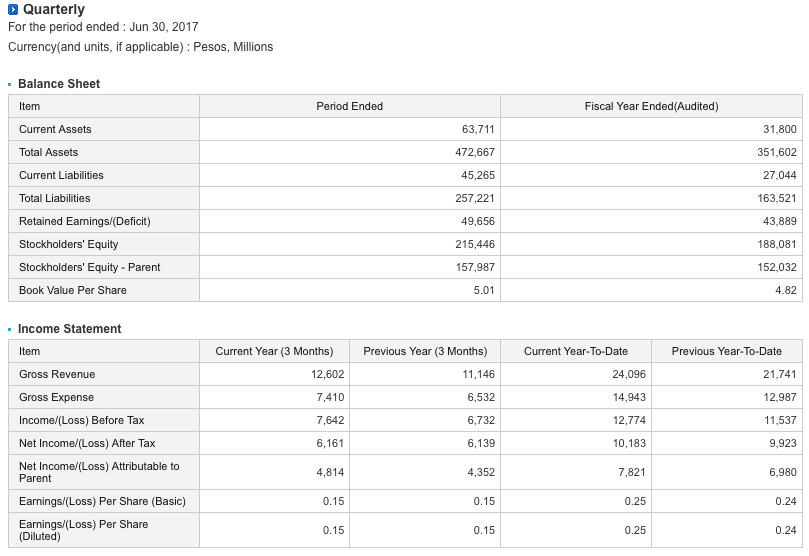
As of Oct 06, 2017, MPI was last traded price at 6.88Php. This is just 1.37 times higher compared to their recorded book value as according to their June 2017 quarterly report. In terms of this parameter, a value investor may find the market price to be still acceptable.
In terms of P/E, the company recorded a trailing P/E of 18.11 meaning, for every 1PHP earning last 2016, investors of this company are willing or is paying 18.11Php. In terms of P/E, it seems like it's still in the not expensive range but, let us take a look further on the company PEG ratio. With the P/E value and with a growth rate of just 11.76% from 2015 to 2016, the company trailing PEG ratio would be 1.54 which means, investors of this company are paying 18.11Php for every 1PHP income last 2016 for a growth rate of 11.76%. In terms of this parameter, a value investor may find this share to be a bit overvalued since the PEG ratio is already more than 1. Fair value stocks usually have a P/E that is equal to the growth rate.
In terms of income, the first 6 months net income attributable to parent this year increases by 12.05% in comparison to last year first 6months net income but the EPS grows only by 4%. Why is this? Well, perhaps part of the increase in income was due to the issuance of an additional share which was converted into income.
Disclaimer: Trade or invest at your own risk.
<P.S> Are you in Singapore? Confused and hardly able to understand what I'm talking about? Message me on facebook.
Monday, October 2, 2017
How Expensive is Crown Asia Chemical Corp (CROWN) now fundamentally based on their June 2017 Quarterly Report?
Crown Asia Chemicals Corporation (CROWN) was incorporated and registered with the Securities and Exchange Commission (SEC) as Crown Asia Compounders Corporation on February 10, 1989 primarily to engage in, operate, conduct, and maintain the business of manufacturing, importing, exporting, buying, selling or otherwise dealing in, at wholesale and retail such goods as plastic and/or synthetic resins and compounds and other allied or related products of similar nature. On September 29, 2014, the SEC approved the change of the Company’s name to the present one.
In 1998, the Company began the production of PVC flexible electrical pipes. Soon after, the Company’s range of product lines expanded further with the introduction of PVC electrical conduit pipes and potable water pipes in 2000, and sanitary pipes and fittings in 2002. In 2003, the Company started to develop and market PVC compounds for use in integrated circuit (IC) packaging tubes, films and bottles, as well as door and window profiles. In 2006, CROWN explored the HDPE market by engaging in marketing and trading HDE pipes and fittings, which were supplied by and HDPE pipes manufacturer and importer. In November 2013, the Company started manufacturing its own HDPE pipes.
At present, CROWN is engaged in the production of plastic compounds, plastic pipes and other related products such as polyvinyl chloride (PVC) pellets, which are used directly and indirectly in the construction and telecommunications industries. The Company derives its revenues from the operations of its two business groups, namely, the compounds group and the pipes group. CROWN sells its compounds to manufacturers of wires and cables, IC tubes, films and sheets, and bottles, among others, while of pipes are sold to hardware dealers, wholesalers, and distributors and to bidded construction projects.
At present, CROWN is engaged in the production of plastic compounds, plastic pipes and other related products such as polyvinyl chloride (PVC) pellets, which are used directly and indirectly in the construction and telecommunications industries. The Company derives its revenues from the operations of its two business groups, namely, the compounds group and the pipes group. CROWN sells its compounds to manufacturers of wires and cables, IC tubes, films and sheets, and bottles, among others, while of pipes are sold to hardware dealers, wholesalers, and distributors and to bidded construction projects.
The Company’s products are located in Guiguinto, Bulacan and in its Davao branch.

Disclaimer: Trade or invest at your own risk.
<P.S> Are you in Singapore? Want to learn how to read stocks fundamentally? PM me on my fb page.

As of Sept 29, 2017, CROWN was last traded price at 1.93Php. This is just 1.25 times higher compared to their recorded book value as according to their June 2017 quarterly report. In terms of this parameter, a value investor may find the market price to be still acceptable.
In terms of P/E, the company recorded a trailing P/E of 10.7 meaning, for every 1PHP earning last 2016, investors of this company are willing or is paying 10.7Php. In terms of P/E, it seems like it's not yet expensive but, let us take a look further on the company PEG ratio. With the P/E value and with a growth rate of just 5.88% from 2015 to 2016, the company trailing PEG ratio would be 1.8 which means, investors of this company are paying 10.7Php for every 1PHP income last 2016 for a growth rate of only 5.88%. In terms of this parameter, a value investor may find this share to be overvalued since the PEG ratio is already more than 1.
In terms of income, the first 6 months net income after tax this year increases by 4.9% in comparison to last year first 6months net income.
<P.S> Are you in Singapore? Want to learn how to read stocks fundamentally? PM me on my fb page.
Sunday, September 10, 2017
Know Your Stocks - How Expensive is Cosco Capital. (COSCO) fundamentally based on their June 2017 Quarterly Report?
Cosco Capital Inc. (COSCO), formerly Alcorn Gold Resources Corporation, was originally incorporated on January 19, 1988 with the primary purpose of engaging in exploration, development, and production of oil and gas, and metallic and non-metallic reserves in partnership with other companies or in its individual capacity. On January 13, 2000, the Securities and Exchange Commission (SEC) approved the amendment of the Company's primary purpose from an oil and mineral exploration and development corporation into a holding company.
On April 12 2013, Lucio L. Co. Group (LLCG) and COSCO executed a Deed of Agreement in payment for the subscription wherein the LLCG shall subscribe to the unissued unauthorised capital stock of the Company. Ten (10) days later, the SEC approved the change in corporate name to the present one.
COSCO, as a holding company, currently has a portfolio comprised of interests in retail, real estate and property leasing, liquor distribution, oil and mining, and specialty retail. The Company's retail interests include Puregold Price Club, Inc. and S&R Membership Shopping. COSCO’s real estate and property leasing interests include Ellimac Prime Holdings, Inc., Fertuna Holding Corporation, Patagonia Holdings Corp., Nation Realty, Inc., 118 Holdings, Inc., NE Pacific Shopping Centers Corporation, and Pure Petroleum Corp. The interests of the Company in Liquor distribution include Montosco Inc., Meritus Prime Distributions, Inc., and Premier Wine and Spirits, Inc. The Company’s oil and mining interests include Alcorn Petroleum and Minerals Corporation. In specialty retail, COSCO’s interests include Liquigaz Philippine Corporation and Office Warehouse, Inc.

As of 8th of September 2017, COSCO was last traded price at 8.1PHP. This is 23.3% lower compared to their recorded book value as of June 2017 quarterly report. In terms of this parameter, it's possibly undervalued since the company net worth is more than the market price.
On April 12 2013, Lucio L. Co. Group (LLCG) and COSCO executed a Deed of Agreement in payment for the subscription wherein the LLCG shall subscribe to the unissued unauthorised capital stock of the Company. Ten (10) days later, the SEC approved the change in corporate name to the present one.
COSCO, as a holding company, currently has a portfolio comprised of interests in retail, real estate and property leasing, liquor distribution, oil and mining, and specialty retail. The Company's retail interests include Puregold Price Club, Inc. and S&R Membership Shopping. COSCO’s real estate and property leasing interests include Ellimac Prime Holdings, Inc., Fertuna Holding Corporation, Patagonia Holdings Corp., Nation Realty, Inc., 118 Holdings, Inc., NE Pacific Shopping Centers Corporation, and Pure Petroleum Corp. The interests of the Company in Liquor distribution include Montosco Inc., Meritus Prime Distributions, Inc., and Premier Wine and Spirits, Inc. The Company’s oil and mining interests include Alcorn Petroleum and Minerals Corporation. In specialty retail, COSCO’s interests include Liquigaz Philippine Corporation and Office Warehouse, Inc.

As of 8th of September 2017, COSCO was last traded price at 8.1PHP. This is 23.3% lower compared to their recorded book value as of June 2017 quarterly report. In terms of this parameter, it's possibly undervalued since the company net worth is more than the market price.
In terms of P/E, the company recorded a trailing P/E of 12.2 meaning, for every 1PHP earning last 2016, investors of this company are willing or is paying 12.2PHP only. With a 12.2 P/E and with a growth rate (change in EPS) of 6.4% from 2015 to 2016, the company trailing PEG ratio would be 1.9 which is more than 1.0 meaning, investors of this company are paying 12.2PHP for every 1PHP income last 2016 even if the company grows only by 6.4% from 2015 to 2016.
In terms of income, the first 6 months net income attributable to parents increases by 5.4% in comparison to last year first 6 months net income.
In terms of income, the first 6 months net income attributable to parents increases by 5.4% in comparison to last year first 6 months net income.
Disclaimer: Trade or invest at your own risk.
Friday, May 19, 2017
Subscribe to:
Posts (Atom)
Advertisement

Click the picture to be redirected to facebook page