Monday, July 20, 2020

Is ALI fundamentally and technically sound to buy based on their March 2020 financial report and current price?

Ayala Land, Inc. (ALI) was formerly the real estate division of Ayala Corporation (AC) and was incorporated on June 30, 1988 to focus on the development of its existing real estate assets. In July 1991, the Company became publicly-listed through an initial public offering of its primary and secondary shares on the Makati and Manila Stock Exchanges.


ALI is engaged in the planning and development of large scale, integrated estates having a mix of use for the sale of residential lots and buildings, office buildings and commercial and industrial lots, leasing of commercial and office spaces and the development, operation and management of hotels and resorts. The Company also develops commercial and industrial parks and is also engaged in property management, construction and other businesses like retail and healthcare. 


Among the Company's subsidiaries are Alveo Land Corporation; Avida Land Corporation; Ayala Property Management Corporation; Makati Development Corporation; North Triangle Depot Commercial Corporation; Laguna Technopark, Inc.; and Ten Knots Philippines, Inc.


As of July 17, 2020, ALI was last traded at 31.7php per share, down by 3.65% from the previous trading. What valuation can we get from their March 2020 quarterly report?


Trailing P/E: 31.7/2.25= 14 Indicating that for every 1php income last 2019, investors are willing to pay or is paying 14php. It is said that an overvalued company would be the one trading at a rate that’s 50 times earnings, or this could be a gauge on how optimistic are investors on this company. A lower P/E may imply low in optimism perhaps due to lower expectation on future earning, or news i.e pandemic that greatly impact investor optimism. 

For a growth rate of 13.6% change in EPS from 2018 to 2019, the PEG ratio would be 14/13.6=1 meaning, investors are paying 14php relative to the growth rate of 13.6% from 2018 to 2019. A PEG ratio of less than 1 is usually considered undervalued, in this case, the market price seems to be just right relative to growth rate 
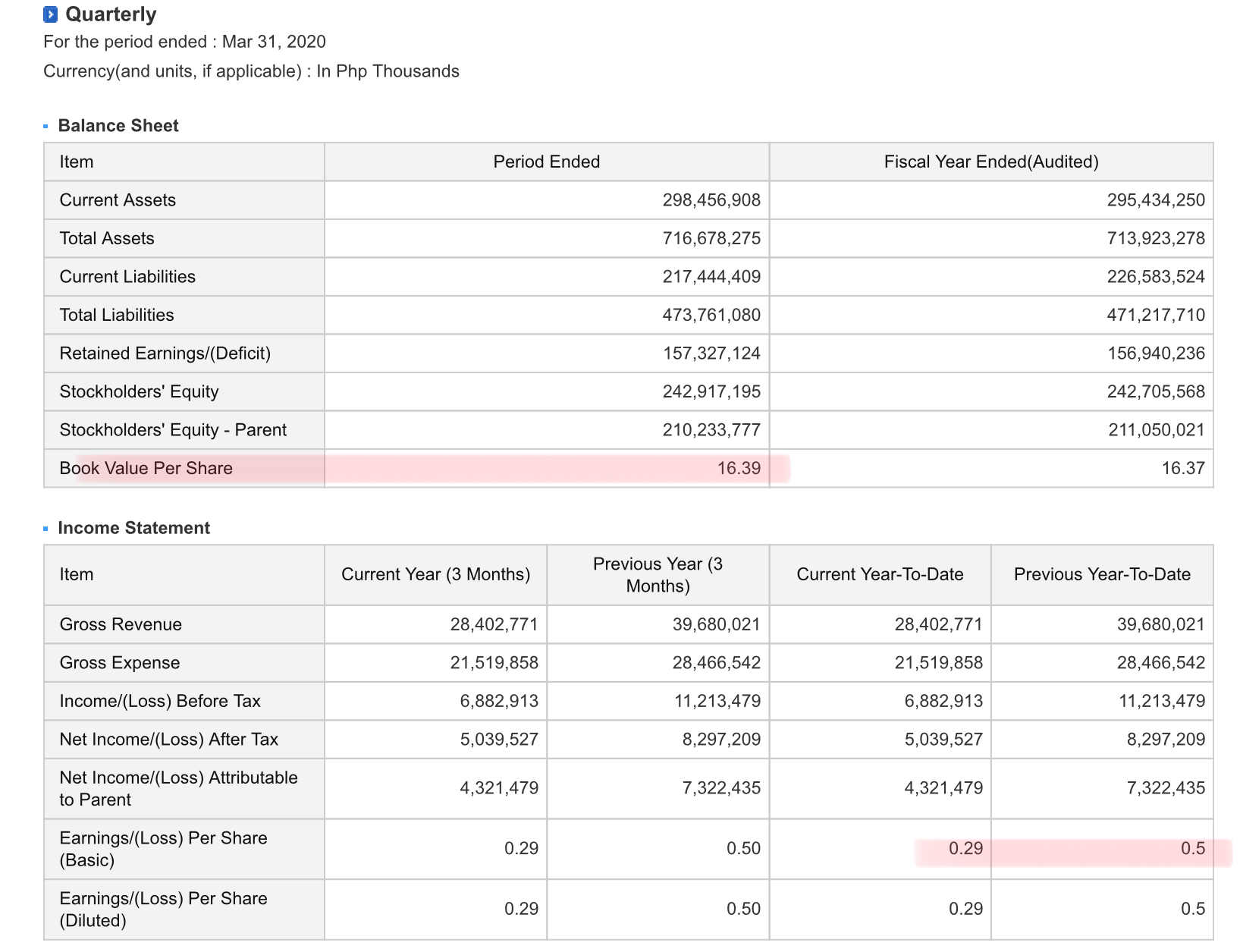
Price to Book Value per share (P/B) = 31.7/16.39= 1.9, meaning, the current market price per share is around 1.9 times higher compare to the real worth of the company as based on their March 2020 financial report. A P/B of less than 3 is potentially undervalued.


However, due to pandemic, their first 3 months net income dropped by 41%, still fundamentally, based on the parameters above, this share seems to be a good buy. 


However technically, the MACD seems to indicate a bearish momentum. RSI also continues to move to an oversold level. If I’m to buy this share, I’ll wait few more trade to see whether the momentum has a sign of reversal to bullish mode.


Disclaimer: Trade or invest at your own risk.

Friday, July 17, 2020

PSE Companies Issuing Dividend for Month of July 2020


Source: PSE edge


FAQ about Dividends


Q1. What is Ex dividend Date?


A1. It means the date set by the Exchange starting from which the buyer is no longer entitled to the dividends. Currently set at 3 business days before record date.


Q2: What if I buy stocks before Ex dividend date, will I be entitled for the dividend?


A2. Yes, but if you purchase a stock on the ex-dividend date or after, you will not receive the next dividend payment. Instead, the seller gets the dividend. If you purchase before the ex-dividend date, you get the dividend.


Q3: What if I buy stocks before ex dividend date but sell it before the record date or payment date, will I still be entitled for the dividend?


A3: Yes you will still be entitled, but note that by the time the stock is sold, it will decline in value by the amount of the dividend. The broker will get the commission and the buyer might just break even.


Why does the stock price decline right after the dividend is paid? Because that's the way the markets work.


Key Takeaways


- When a stock dividend is paid, the stock's price immediately falls by a corresponding amount.


- The market effectively adjusts the stock's price to reflect the lower value of the company, which could wipe out any gain sought by a short-term buyer.


- In addition, the buyer owes taxes on those dividends.


Click here for the source


Q4: What is record date?


A4: It means the date on which stockholders must officially own shares in order to be entitled to any shareholders rights or dividends, but if you buy share on this date, you will not be entitled, you must buy before ex dividend date to be entitled. 

Thursday, July 16, 2020

Is EW fundamentally and technically sound to buy based on their March 2020 financial report and current price?

East West Banking Corporation (EW) was registered with the Securities and Exchange Commission on March 22, 1993. The Company was granted authority by the Bangko Sentral ng Pilipinas (BSP) to operate as a commercial bank in 1994 and commenced operations on July 8 of the same year. 


EW's principal banking products and services include deposit-taking, loan and trade finance, treasury, trust services, credit cards, cash management and custodial services. The Company offers the financial services to consumer and corporate clients. On January 25, 2012, EW obtained from BSP the approval to operate as a universal bank.


On May 6, 2016, EastWest and Standard Chartered Bank Philippines (SCB PH) entered into an agreement for SCB PH’s retail business. Under the agreement, the credit cards, personal loans, wealth management and deposits of SCB in the Philippines will be migrated to EastWest.


The Company's wholly-owned subsidiaries are East West Rural Bank, Inc.; East West Insurance Brokerage, Inc.; Quest Marketing and Integrated Services, Inc.; East West Leasing and Finance Corporation, and Assurance Solutions Insurance Agency. EW also owns 50% of East West Ageas Life Insurance Corporation, a life insurance firm formed with Ageas Insurance International N.V.


As of December 31, 2018, EW has a network of 390 branches and 583 automated teller machines, majority of which are located within Metro Manila.


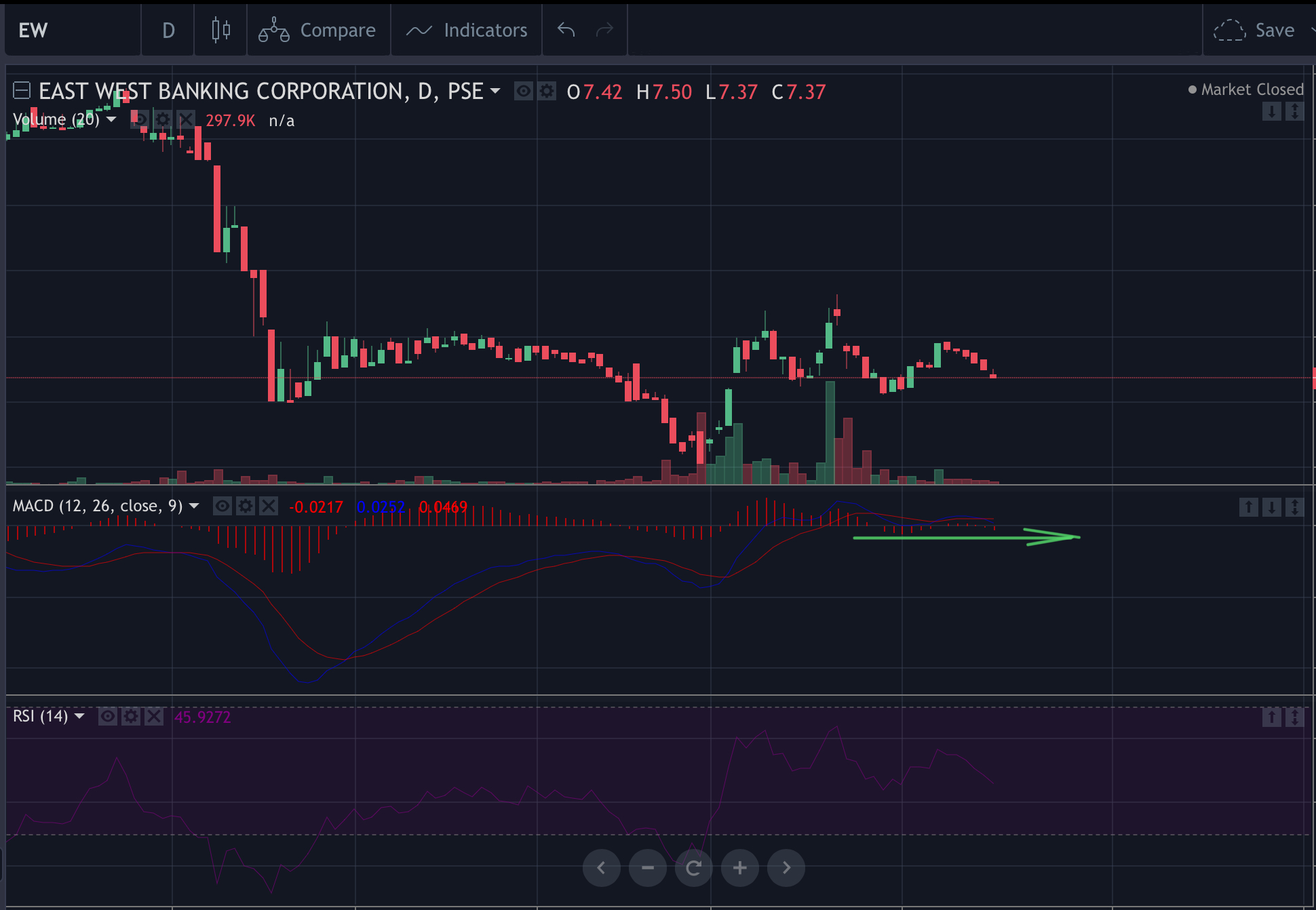
As of July 15, 2020, EW was last traded at 7.37php per share. What valuation can we get from their March 2020 quarterly report?


Trailing P/E: 7.37/2.77= 2.6 Indicating that for every 1php income last 2019, investors are willing to pay or is paying 2.6php only. It is said that an overvalued company would be the one trading at a rate that’s 50 times earnings, or this could be a gauge on how optimistic are investors on this company. A lower P/E may imply low in optimism perhaps due to lower expectation on future earning, or news i.e pandemic that greatly impact investor optimism.


For a growth rate of 38.5% change in EPS from 2018 to 2019, the PEG ratio would be 2.6/38.5=0.06 meaning, investors are paying 2.6php relative to the growth rate of 38.5% from 2018 to 2019. A PEG ratio of less than 1 is usually considered undervalued.


Price to Book Value per share (P/B) = 7.37/22.74= 0.3, meaning, the current market price per share is 67.5% lower compare to the real worth of the company as based on their March 2020 financial report. A P/B of less than 3 is potentially undervalued


In spite of pandemic, their first 3 months net income increase by 74.7%.


Fundamentally, based on the parameters above, this share seems to be a good buy to accumulate. Once the pandemic is over, this share will eventually catch up to its real worth.


However technically, the MACD histogram seems to indicate a sideway momentum. If you are into longterm investing, I suggest you accumulate this share.


Disclaimer: Trade or invest at your own risk.

Advertisement

Advertisement
Click the picture to be redirected to facebook page