Friday, January 13, 2017

How Expensive is Philippine National Bank (PNB) Fundamentally?

Philippine National Bank (PNB) was incorporated on July 22, 1916 to engage in the general commercial banking business. PNB provides a range of banking and financial services to corporate, middle-market, small and medium enterprises and retail customers, including overseas Filipino workers, as well as to the Philippine national government, national government agencies, local government units and government-owned and -controlled corporations in the Philippines.

PNB's principal commercial banking activities include deposit-taking, lending, trade financing, foreign exchange dealings, bills discounting, fund transfers/remittance servicing, asset management, treasury operations, comprehensive trust services, retail banking and other related financial services. The Company'Ss banking activities are undertaken through the following groups namely, institutional banking; retail banking; consumer finance; global Filipino banking; treasury; trust banking; credit management; remedial management; and special assets management.

In December 2015, Allianz and PNB reached an agreement to enter into a 15-year exclusive distribution partnership on bancassurance products and for Allianz to acquire 51% of PNB Life Insurance Inc., the life insurance subsidiary of PNB. The joint venture company will operate under the name of "Allianz PNB Life Insurance, Inc."

As of December 31, 2015, PNB has a distribution network of 665 domestic branches and 75 overseas branches and 937 automated teller machines nationwide.


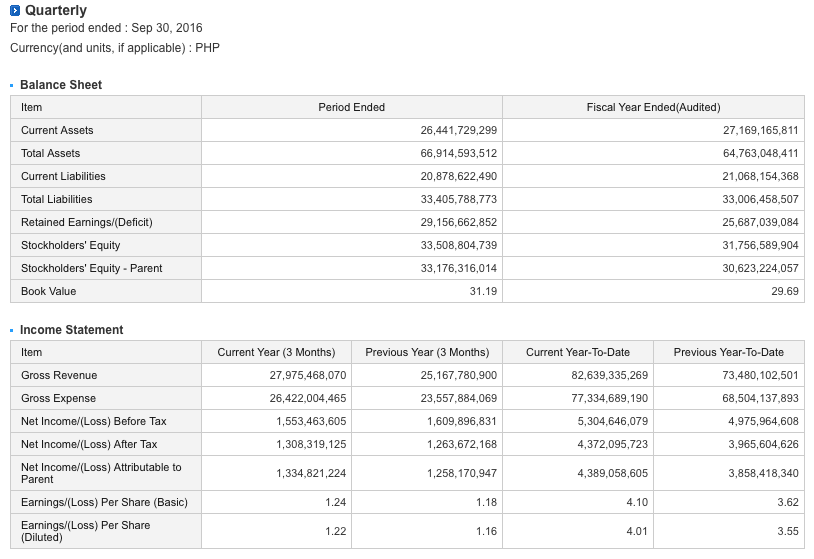
As of 13th of January 2017, PNB was last traded price at PHP 54.80. This is 37% lower compare to their recorded book value as of their September 2016 financial report. Therefore, in terms of price to book value, it's not expensive yet since the book value is higher than the market price. 

In terms of P/E, the company recorded a trailing P/E of 11.21 meaning, for every 1PHP earning last 2015, investors of this company are willing or is paying 11.21PHP only. With a 11.21 P/E and with a growth rate (change in EPS) of 6.3% from 2014 to 2015, the company trailing PEG ratio would be 1.78 which is more than 1.0 meaning, investors of this company are paying 11.21PHP for every 1PHP income last 2015 when the company grows only by 6.3% from 2014 to 2015. Ideally, a fair valued stocks has a PEG ratio of 1.0 meaning, the P/E is equal to the growth rate, in the case of PNB its more than one therefore, possibly overvalued.

In terms of income, the first 9 months net income (attributable to parent) last 2016 increases by 21.93% in comparison to 2015 first 9 months net income (attributable to parent).

As of this writing the annual report of this company for 2016 is not yet disclosed.

Disclaimer: Trade or invest at your own risk.

Thursday, December 22, 2016

How Expensive is Jollibee Food Corporation (JFC)? Updated 3rd Quarter

Jollibee Foods Corporation (JFC) was incorporated on January 11, 1978. JFC's principal business is the development, operation, and franchising of quick-service restaurants under the trade name "Jollibee". In the Philippines, JFC also has, as subsidiaries, Fresh N' Famous Foods, Inc., which develops, operates and franchises quick-service restaurants under the trade names "Chowking" and "Greenwich"; Red Ribbon Bakeshop, Inc., which develops, operates and franchises restaurants under the "Red Ribbon" trade name; Mang Inasal Phils., Inc. (MIPI), which develops, operates and franchises restaurants under the "Mang Inasal" trade name; and Perf Restaurants, Inc., which franchises restaurants under the "Burger King" trademark in the Philippines.

JFC also has subsidiaries and affiliates overseas which develop and operate its international brands, "Yonghe King", "Hong Zhuang Yuan", "San Pin Wang" brands under the SuperFoods Group, "12 Hotpot", "Jinja" and "Dunkin' Donuts".

On October 13, 2015, the Company's wholly-owned subsidiary, Bee Good! Inc., entered into an agreement with Smashburger Master LLC to acquire 40% of "Smashburger", a fast casual better burger brand in the US. In April 2016, JFC acquired the remaining 30% share in MIPI, making the latter wholly-owned by the Company.

By the end of 2015, there were 916 Jollibee stores nationwide, of which 459 were franchised and 457 are Company-owned. In international operations, Jollibee had 139 stores with 32 stores in the US, 72 in Vietnam, 13 in Brunei, one in Hong Kong, two in Singapore, and 19 in the Middle East.


As of Dec 22, 2016, JFC was last traded price at PHP 185.50. This is 5.95 times higher compare to their recorded book value as according to their September 2016 financial report. This is expensive for most value investor since, a PBV of more than 3 is considered expensive.

In terms of P/E, the company recorded a trailing P/E of 40.24 meaning, for every 1PHP earning last 2015, investors of this company are willing or is paying 40.24PHP which is quite expensive. With a 40.24 P/E and with a negative growth since EPS dropped from 5.03 to 4.61 from 2014 to 2015 respectively, the company trailing PEG ratio would also be negative which means, investors of this company are paying 40.24PHP for every 1PHP income last 2015 even though, the company grows negatively from 2014 to 2015.

In terms of income, the first 9 months net income attributable to parents this year increases by 13.75% in comparison to last year first 9 months net income.

Disclaimer: Trade or invest at your own risk.
Monday, December 19, 2016

How Expensive is Cosco Capital, Inc. (Cosco)? 3rd Quarter Updated

Cosco Capital Inc. (COSCO), formerly Alcorn Gold Resources Corporation, was originally incorporated on January 19, 1988 with the primary purpose of engaging in exploration, development, and production of oil and gas, and metallic and non-metallic reserves in partnership with other companies or in its individual capacity. On January 13, 2000, the Securities and Exchange Commission (SEC) approved the amendment of the Company's primary purpose from an oil and mineral exploration and development corporation into a holding company.

On April 12 2013, Lucio L. Co. Group (LLCG) and COSCO executed a Deed of Agreement in payment for the subscription wherein the LLCG shall subscribe to the unissued unauthorized capital stock of the Company. Ten (10) days later, the SEC approved the change in corporate name to the present one.

COSCO, as a holding company, currently has a portfolio comprised of interests in retail, real estate and property leasing, liquor distribution, oil and mining, and specialty retail. The Company's retail interests include Puregold Price Club, Inc. and S&R Membership Shopping. COSCO's real estate and property leasing interests include Ellimac Prime Holdings, Inc., Fertuna Holding Corporation, Patagonia Holdings Corp., Nation Realty, Inc., 118 Holdings, Inc., NE Pacific Shopping Centers Corporation, and Pure Petroleum Corp. The interests of the Company in Liquor distribution include Montosco Inc., Meritus Prime Distributions, Inc., and Premier Wine and Spirits, Inc. The Company's oil and mining interests include Alcorn Petroleum and Minerals Corporation. In specialty retail, COSCO's interests include Liquigaz Philippine Corporation and Office Warehouse, Inc.


As of 19th of December 2016, COSCO was last traded price at PHP 8.53. This is 13.75% lower compare to their recorded book value as of their September 2016 financial report. Therefore, in terms of price to book value, it's not expensive yet since the book value is higher than the market price. 

In terms of P/E, the company recorded a trailing P/E of 13.76 meaning, for every 1PHP earning last 2015, investors of this company are willing or is paying 13.76PHP only. With a 13.76 P/E and with a growth rate (change in EPS) of 14.81% from 2014 to 2015, the company trailing PEG ratio would be 0.93 which is less than 1.0 meaning, investors of this company are paying only 13.76PHP for every 1PHP income last 2015 when the company grows by 14.81% from 2014 to 2015. Ideally, a fair valued stocks has a PEG ratio of 1.0 meaning, the P/E is equal to the growth rate, in the case of COSCO its less than one therefore, possibly undervalued.

In terms of income, the first 9 months net income after tax this year increases by 9.33% in comparison to last year first 9 months net income.

Disclaimer: Trade or invest at your own risk.

Advertisement

Advertisement
Click the picture to be redirected to facebook page